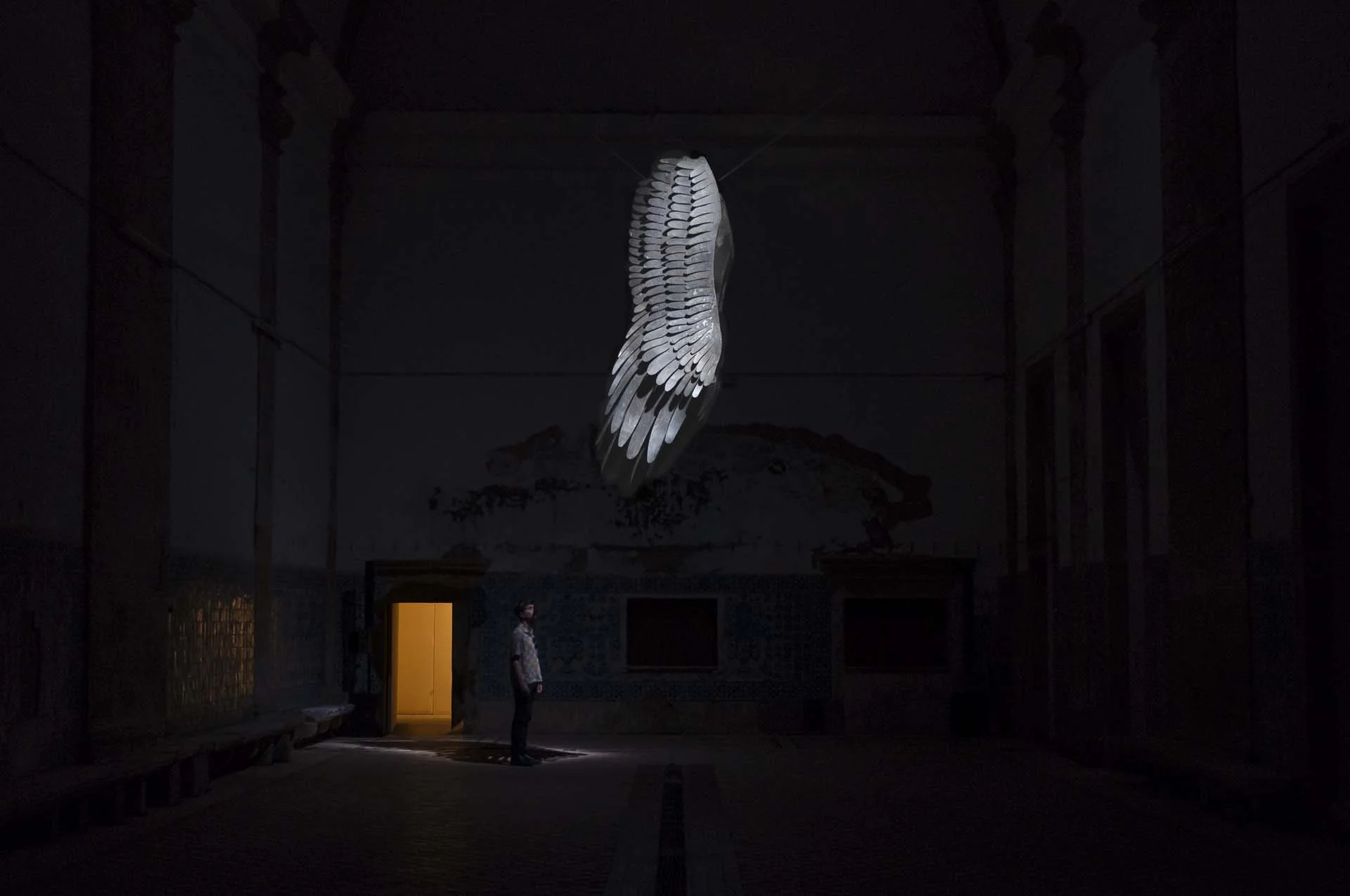
To hold, to give, to receive | Anozero 2026
Anozero – Coimbra Biennial of Contemporary Art returned in 2026 with To hold, to give, to receive, an ambitious and deeply moving exhibition exploring memory, displacement, solidarity and the ways we live together. Curated by Hans Ibelings and John Zeppetelli, with Daniel Madeira as assistant curator, the biennial brought together international artists, architects and researchers whose practices addressed some of the most urgent political, social and environmental questions of our time.
Founded in 2015, Anozero has become one of Portugal's most significant contemporary art events, distinguished by its extraordinary relationship with Coimbra's architectural heritage. At its heart is the magnificent 17th-century Monastery of Santa Clara-a-Nova, a former convent and military barracks overlooking the Mondego River. Each edition brings contemporary art into dialogue with the monastery's history and architecture, while extending into museums, gardens and other spaces throughout the city.
The 2026 edition was particularly powerful in its willingness to confront difficult subjects. Works by Forensic Architecture, Taysir Batniji and Adam Broomberg and Rafael Gonzalez addressed violence and displacement, while Maria Trabulo reflected on the destruction of cultural heritage in Syria. Elsewhere, artists including Nan Goldin, Taryn Simon, Shilpa Gupta, Julian Charrière and Jonathas de Andrade explored questions of memory, grief, resistance, ecology and the complicated relationships between care and power.
The exhibition's title, To hold, to give, to receive, offered a simple starting point for these conversations. Across the biennial, acts of holding, giving and receiving became ways of thinking about hospitality, responsibility and coexistence. The artworks were often challenging, sometimes unsettling, but also profoundly humane.
I’ve had the pleasure of working with Anozero and its director, Carlos Antunes, for the past three years, supporting the biennial’s international communications strategy and media outreach through Pickles PR. Our approach has focused on introducing international journalists to Anozero's distinctive curatorial vision, its remarkable setting and the increasingly important place it occupies within the European contemporary art landscape.
For the 2026 edition, the exhibition's political urgency offered opportunities to engage audiences beyond the traditional arts press. Alongside outreach to international art and culture editors, we explored stories connecting contemporary artistic practice with architecture, cultural heritage, geopolitics and the role of art in bearing witness to conflict. An important part of this work was helping journalists understand the relationship between the artworks and the spaces in which they were presented, particularly the monastery, whose complex history and contested future added another dimension to the exhibition.
On a personal level, as a Canadian I was delighted to see the curatorial perspectives of Hans Ibelings, based in Toronto, and John Zeppetelli, whose career has included leading the Musée d'art contemporain de Montréal, brought together in Coimbra. Their approach was uncompromising, thoughtful, and deeply affecting. Returning to Coimbra is always one of the great pleasures of this project. It’s a beautiful, historic university city with a remarkable cultural life, and I've come to deeply appreciate the generosity, commitment and imagination of the people behind the biennial, in particular their willingness to take risks and to trust artists and audiences to engage with complexity.